

Berlin Blue
Artistic and experimental approaches to a colour
How can one make a colour, its origins and its properties visible?
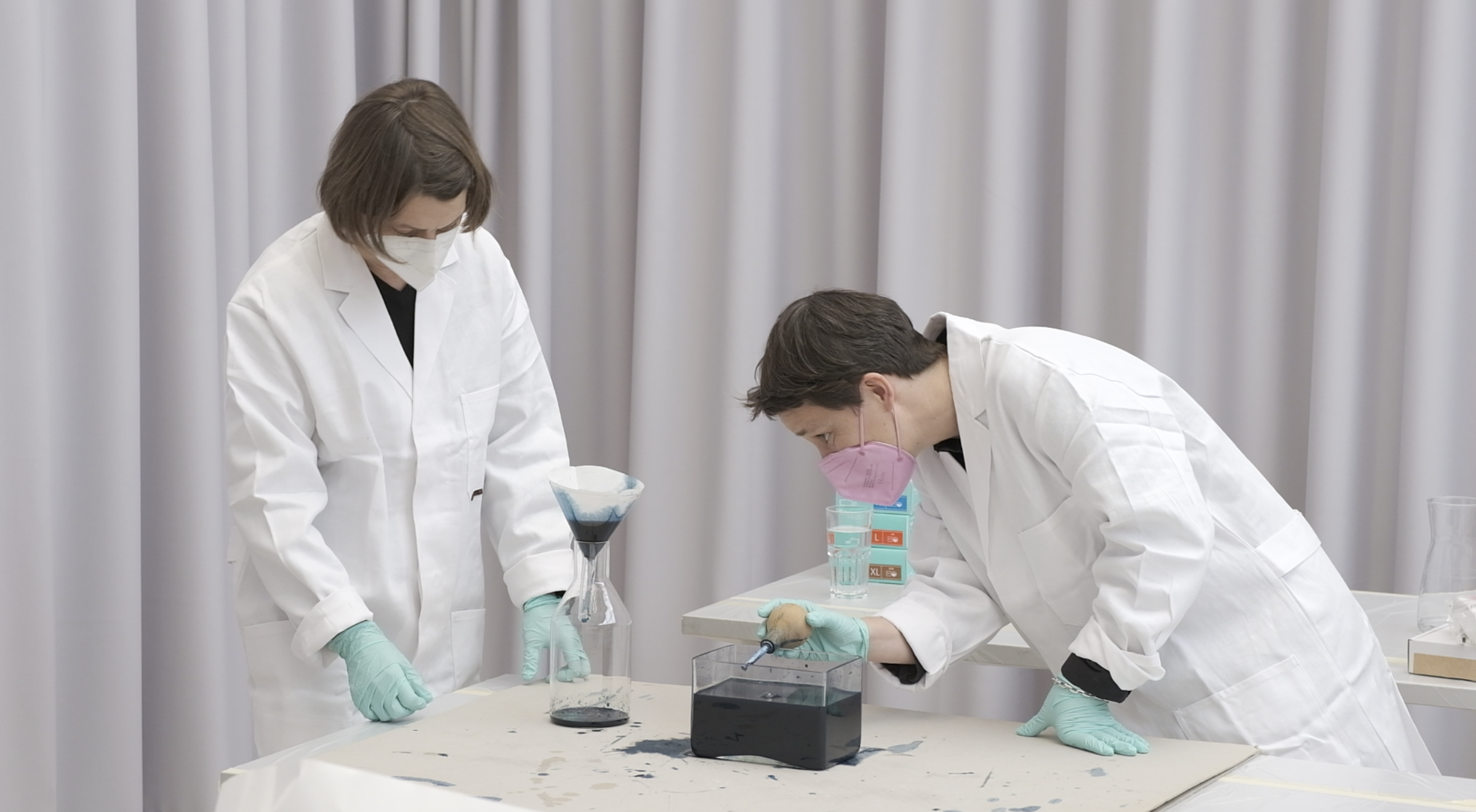
Britta Lange and Kerstin Stoll explore Berlin Blue, a synthetic deep-blue pigment first produced in Berlin in 1706, through an artistic and experimental lens. During the talk, we will produce it ourselves and explore its material, historical and political connections: for instance, its various names in the 18th century – Diesbach Blue, Turnbull’s Blue, Prussian Blue, Bleu de Paris, Milori Blue, Saxon Blue, China Blue – when there was no such thing as patent law, or its use in Chinese green tea in the 19th century.
In doing so, we examine Western concepts that remain relevant today and shape contemporary narratives such as that of ‘Chinese trash’: original and copy, origin, discovery, ownership, authorship and copyright.
Duration: 90 minutes (approx. 60 mins’ lecture and experiment, plus 30 mins’ discussion)
Participants
Britta Lange is a cultural theorist and author. She works as a lecturer at the Institute for Cultural History and Theory at Humboldt-Universität zu Berlin and is currently guest professor for Visual Cultures at Weissensee Kunsthochschule Berlin. Her research focuses on cultural history and cultural techniques, colonialism and postcolonial approaches, history of knowledge, early photo, film and sound documents. Recent publications include Passfotos unter Zwang. Deutsche Fotopolitik im Ersten Weltkrieg, Berlin 2025; Captured Voices. Sound Recordings of Prisoners of War from the Sound Archive 1915-1918, Berlin 2022. Britta Lange lives and works in Berlin.
Kerstin Stoll views her artistic practice as a cultural technique: she evokes ongoing processes of transfer that bridge the gap between the artistic sphere and the realm of science. She translates her experimental, process-oriented working method into installations, sculptures and video collages that exemplify aspects of bionics, materials research, the latest construction and digital representation techniques, as well as anthropological research and sustainable architecture.
As part of a scientific-artistic collaboration in 2021, Britta Lange and Kerstin Stoll jointly conducted experiments with Prussian blue in the Zentrum für Kulturtechnik’s (ZfK) Object Laboratory. They presented their research, amongst other things, in the lecture series “Politics of Colour” (2021) at the Institute for Cultural Studies. At TAT, they are now presenting their jointly authored and designed publication Berliner Blau, which has been published on the HU’s e-doc server.
The event is moderated by TA T Head Curator Felix Sattler. In 2021, he participated in Britta Lange’s and Kerstin Stoll’s experiments at the Zentrum für Kulturtechnik’s (ZfK) Object Laboratory, a facility he co-developed with Jochen Hennig.
Accessibility
The lecture theatre is accessible via a lift. The historic seating is not accessible to people with reduced mobility. Seats and wheelchair spaces for people with reduced mobility are provided directly within the lecture theatre.
Important change: The talks will be made accessible to Deaf and hard-of-hearing people through AI-generated subtitles. Unfortunately, due to technical difficulties, automatic transcription will not be available for this event. However, the presenters will add extensive written commentary to their slides, in order to make the presentation understandable for Deaf and hard-of-hearing audiences. We kindly ask for your understanding. We will try to improve our technical means soon.
The presentation relies heavily on visual content of the experiments and is unfortunately not accessible to blind and partially-sighted audiences.
Diversity and sensitive topics
The talk does not address issues such as colonial violence or racism, but it does explore European stereotypes of China and Chinese stereotypes of Europe.
Credits
- Concept, Speakers: PD Dr. Britta Lange und Kerstin Stoll
- Moderator: Felix Sattler, Curator TA T
In cooperation with

Easy Read Version
How can we see a colour, where it comes from, and what it can do?
This talk is about Berlin Blue.
Berlin Blue is a deep blue colour. It was first made in Berlin in 1706.
Britta Lange and Kerstin Stoll explore Berlin Blue through art and experiments.
During the event, we will make Berlin Blue together.
We will learn about:
- what the colour is made of
- the history of the colour
- how the colour connects to politics and culture
In the 18th century, Berlin Blue had many names. Some names were: Diesbach Blue, Turnbull’s Blue, Prussian Blue, Bleu de Paris, Milori Blue, Saxon Blue, and China Blue.
At that time, there were no patent laws. This meant people could copy materials and ideas more freely.
We will also talk about how Berlin Blue was used in Chinese green tea in the 19th century.
The talk asks questions that are still important today:
- What is an original?
- What is a copy?
- Where does something come from?
- Who discovers something?
- Who owns an idea?
- Who is named as the author?
- What is copyright?
We will also talk about ideas and stereotypes between Europe and China, including the idea of “Chinese trash”.
Duration
The event lasts about 90 minutes.
- about 60 minutes talk and experiment
- about 30 minutes discussion
Participants
Britta Lange is a researcher and writer. She teaches at Humboldt-Universität zu Berlin and at Weissensee Kunsthochschule Berlin. Her work looks at history, culture, colonialism, and archives such as photographs, films, and sound recordings.
Kerstin Stoll is an artist. She works with art and science together. She creates installations, sculptures, and videos. Her work explores materials, technology, nature, and architecture.
In 2021, Britta Lange and Kerstin Stoll worked together on experiments with Berlin Blue at the Zentrum für Kulturtechnik’s Object Laboratory. They later shared this research in talks and a publication called Berliner Blau.
The event is moderated by Felix Sattler, Head Curator of TA T. He also took part in the Berlin Blue experiments in 2021.
Accessibility
The lecture theatre can be reached by lift.
The historic seating is not fully accessible for people with reduced mobility. Accessible seats and wheelchair spaces are available inside the lecture theatre.
The talk will have AI-generated subtitles for Deaf and hard-of-hearing people.
The presentation uses many images and videos from the experiments. Because of this, it is unfortunately not accessible for blind and partially sighted audiences.
Diversity and sensitive topics
The talk does not discuss colonial violence or racism directly.
However, it does explore stereotypes from Europe about China and stereotypes from China about Europe.