

THE DEAD, AS FAR AS [ ] CAN REMEMBER
Knowledge and Controversies about Colonial Violence, Anti-Colonial Resistance, Human Remains and Objects from the Former Colonies in Museums and Collections
The history of colonial violence is remembered in very different ways. It affects individual and collective memories of descendants of the victims. It is deeply related to museums and collections where human remains and objects from the former colonies are kept. It is part of the history of universities – including the Humboldt-Universität – where collections were interpreted, contributing to the scientific justification of colonialism and racism.
Discussing what should be remembered, how and where the material evidence should be kept depends on ‘who is speaking’.
In four chapters, The Dead, as far as [ ] can remember shows the diversity of knowledge and controversies about the colonial past with transnational voices from the past and the present.
Visual and performing artists, academic researchers, museum staff, and decolonial activists have their say.
The exhibition is accompanied by a series of lectures and discussions that link the current state of research at the Humboldt-Universität with non-university perspectives.
Chapters
Chapter 1:
BREAKING THE SILENCE I – DER ZORN DES MDACHI BIN SHARIFU
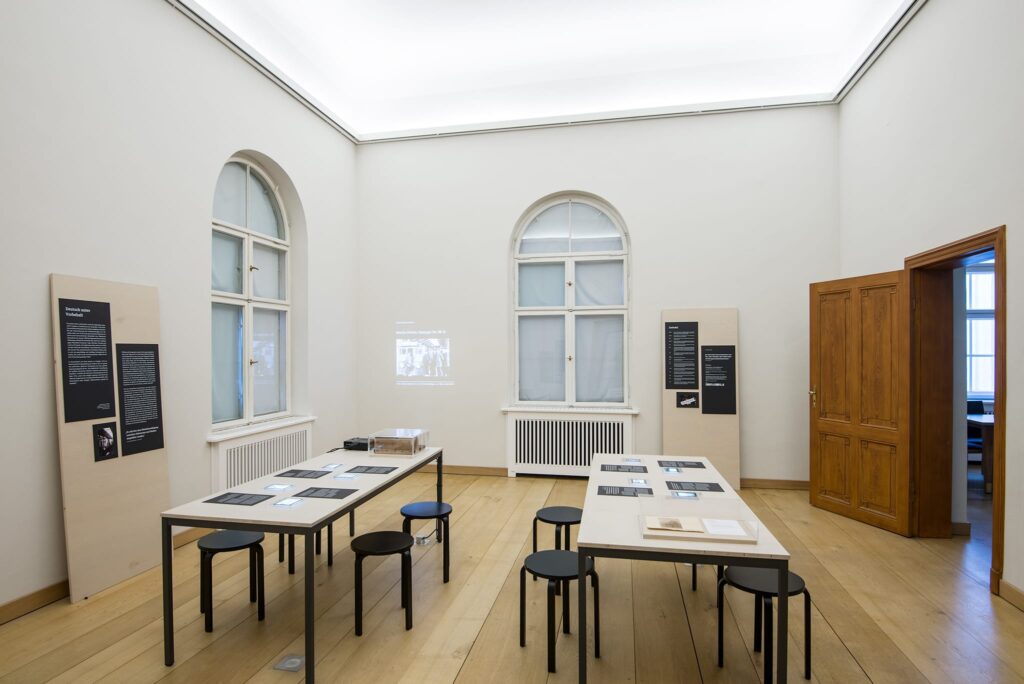
In the late summer of 1919, shortly after Germany’s final loss of its colonies, a young East African named Mdachi bin Sharifu appears in several cities as a speaker on “Our colonial past”. In Berlin, Erfurt and Hamburg it is the first time that a black person rises to speak in this regard. But that is not the only reason why his appearances cause violent reactions from the white audience. Following the governmental repression of a petition by the Afro-German community surrounding Martin Dibobe from Cameroon, Sharifu is now judging publicly both the German colonial regime and the ongoing colonial racism in Germany.
Based on selected photographs from the collection of the plantation owner Karl Vieweg, which the embassy of Tanzania has kindly provided, the exhibition of Berlin Postkolonial questions the long-lived myth of the loyalty of the colonized to the German Empire.
Credits
Created by Berlin Postkolonial. Thanks to the Embassy of the United Republic of Tanzania, the Stiftung Nord-Süd-Brücken, the Berliner Landesstelle für Entwicklungszusammenarbeit, Engagement Global on behalf of the Bundesministeriums für wirtschaftliche Zusammenarbeit und Entwicklung, and the Rosa-Luxemburg-Stiftung.
Chapter 2:
Just Listen
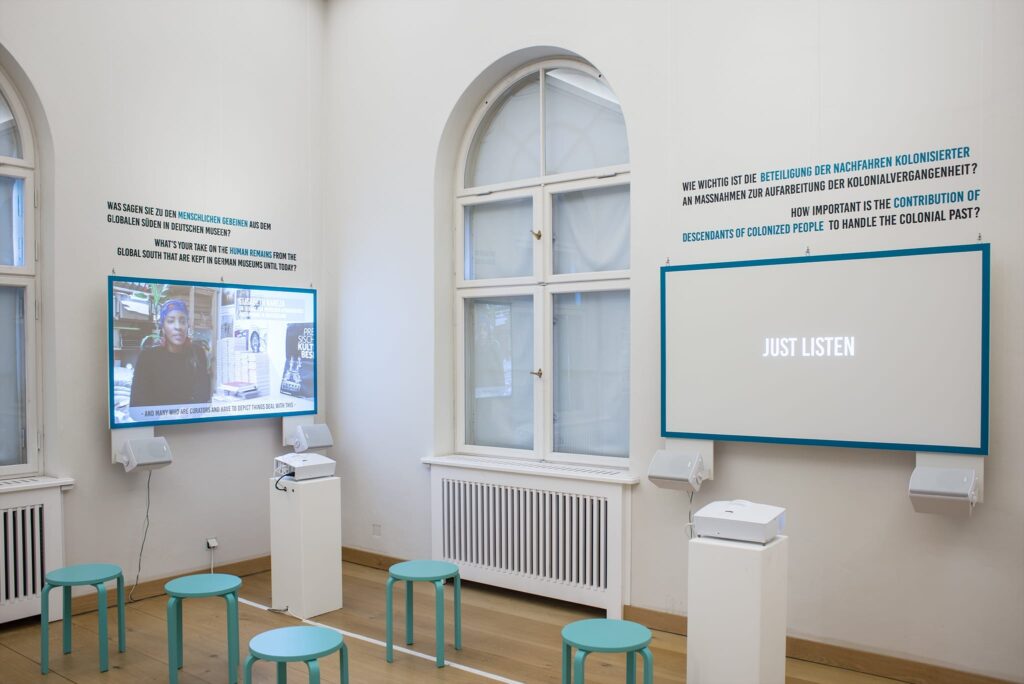
Voices on politics of remembrance and German colonial history. To this day, colonial racism characterizes the coexistence of people worldwide. Nevertheless, and for that very reason, the topic is not given much attention in Europe and the US. The West does not like to talk about the time of its violent expansion, about enslavement and genocide – certainly not with the descendants of colonized people themselves.
Just Listen is a cooperation project of students of the FU Berlin in cooperation with leftvision and Berlin Postkolonial and should give an impulse to engage critically with the history and the continuities of colonialism. Just Listen therefore focuses on the perspectives of people who are affected by these continuities. In interviews, activists and experts who have been advocating a responsible approach to colonialism and racism for many years now, address important questions about appropriate dealings with the German colonial era.
Credits
Created by students of the Freie Universität Berlin in cooperation with Leftvision and Berlin Postkolonial.
Chapter 3:
Dead Images
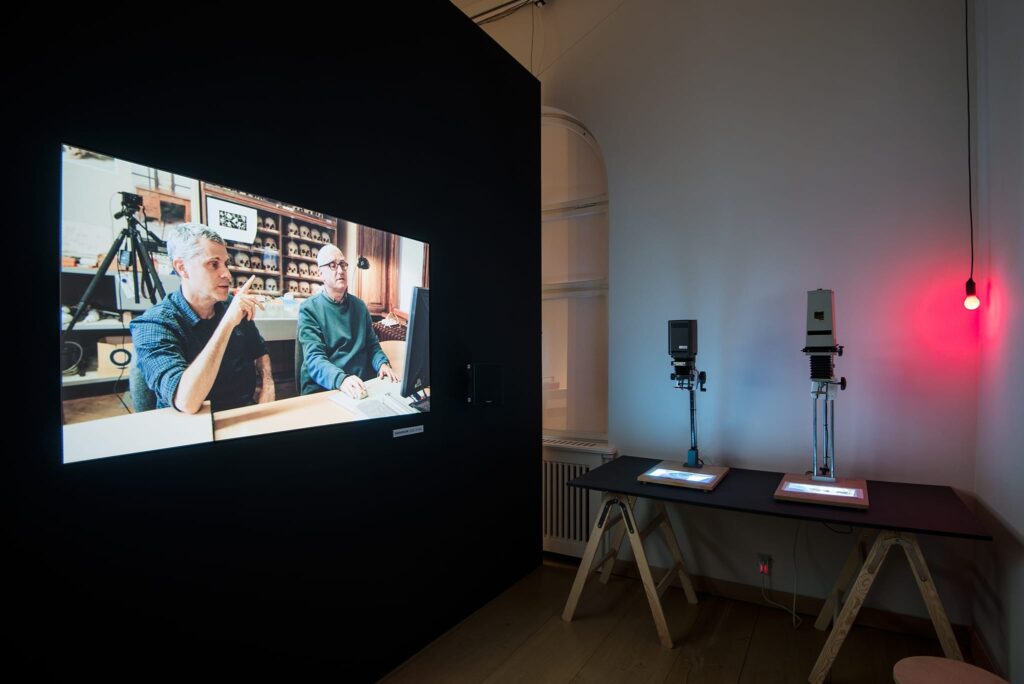
Methods of collecting, measuring, categorizing, storing and displaying skulls, developed in the 19th and early 20th centuries, were entangled in colonialism and scientific racism. Anthropometric, ‘type’ and other forms of anthropological photography – developed as tools to measure, classify and racialise the living – flourished alongside the research on the remains of the dead.
Dead Images, is an exploration of the complex and contentious legacy of two collections held at the anthropology department of the Natural History Museum in Vienna. One collection consists of over 40,000 human skulls. Housed within this collection is a second collection of over 50,000 anthropological photographs.
Through multidisciplinary research, a travelling exhibition, an education programme and public events, the Dead Images project reflects on the ethical, scientific and political implications of such collections and of their display.
Credits
Created by Tal Adler (artist, CARMAH, HU Berlin) with Linda Fibiger (bio-archeologist, University of Edinburgh), John Harries (social anthropologist, University of Edinburgh), Joan Smith (artist, Edinburgh College of Art), Anna Szöke (art historian, CARMAH, HU Berlin) and Maria Teschler-Nicola (physical anthropologist, NHM Vienna).
Dead Images is part of the EU H2020 Project TRACES.
Chapter 4:
Mangi Meli Remains
In Old Moshi, Tanzania, a head is missing. The head is of Chief Meli who fought the German colonial occupation of territory in Kilimanjaro and was executed as a result in 1900. His head is said to have been shipped to Germany at the request of the Ethnological Museum director Felix von Luschan. Von Luschan collected thousands of skulls from all over the world for scientific testing based on racial ideology. Many of the skulls, including those from Old Moshi, are still stored in Berlin. The search for the head of Chief Meli has been ongoing for over 50 years, led by Meli’s grandson but until now without success.
Yet traces of Chief Meli can still be found in songs, stories and archives. This has formed the basis for a Tanzanian-German collaboration where a video installation depicts the life story of Meli: as a freedom fighter, his violent death and the possible journey of his head. Re-examined historical photographs and documents complement the exhibition. Mangi Meli Remains will travel from Berlin via Dar es Salaam to Old Moshi, where the exhibition will remain as a place of remembrance and a placeholder for Chief Meli’s missing head.
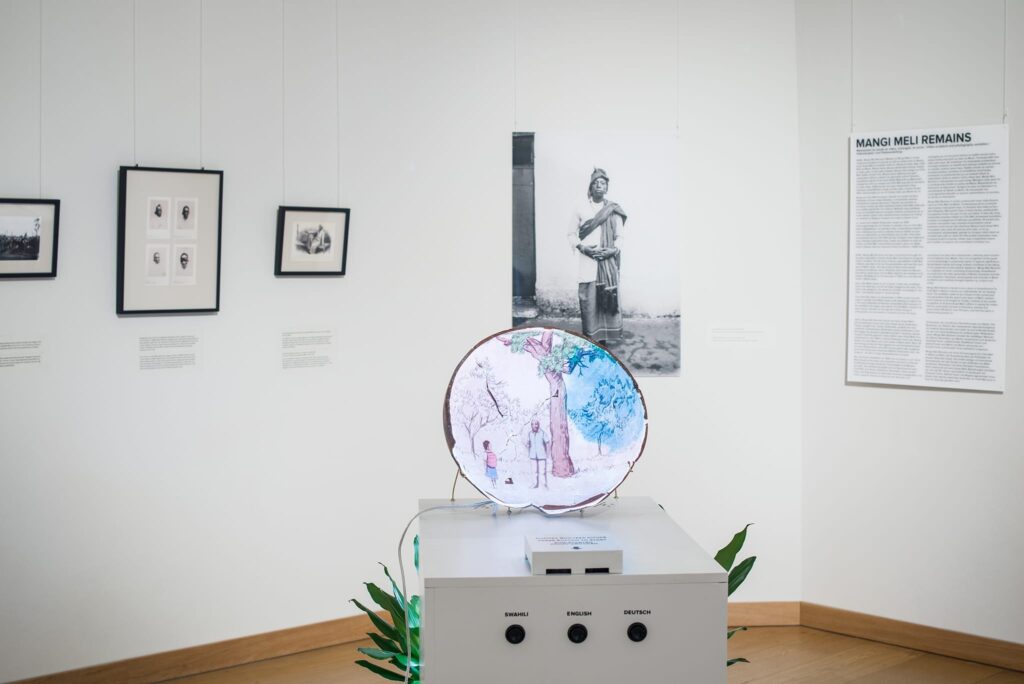
©Flinn Works / Amani Abeid, Foto: Daniel Kovalenko
Credits
A Flinn Works Production in coproduction with Ethnological Museum Berlin. Supported by Senatsverwaltung für Kultur und Europa, Goethe Institute Tanzania and Between Bridges.
Events
Schädel X
Oct 26, Nov 3 & 9, 2018, 8 p.m.
Lecture Performance by Flinn Works (in German)
Artistic Research and Creative Praxis on Colonial Collections and (post)colonial Cultures of Memory
Nov 20, 2018, 7 p.m.
Panel Discussion with Amani Abeid, Anaïs Héraud-Louisadat, Nathalie Anguezomo Mba Bikoro (tbc), Dr. Lili Reyels
Chair: Anne Fleckstein. The event will be held in English
Verlorene Form. Eine transdisziplinäre Auseinandersetzung mit Lebendabgüssen in Gips
8.12.2018, 7 p.m.
Presentation by Dr. Britta Lange, Thomas Schelper, Kerstin Stoll
Provenienzforschung zwischen Forensik und Erinnerungskultur
Jan 17, 2019, 7 p.m.
Discussion with Dr. Larissa Förster and Dr. Holger Stoecker
Chair: Felix Sattler
Credits
See chapters for individual credits.
- Curator: Felix Sattler
- Scenography and curatorial assistance: Katharina von Hagenow, Katharina Otto
- Communication: Luise Wolf
- Exhibition technician: Bernd Michael Weisheit
Partners
The exhibition took part in Berlin Science Week 2018
Easy Read Version
What is this exhibition about?
This exhibition is about colonial violence.
Colonial violence means:
People and countries were controlled, exploited, and harmed by colonial powers.
People remember this history in different ways.
For many people,
this history is still important today.
It affects families
and communities of people
whose ancestors were harmed.
Museums and universities
are also part of this history.
Some museums and collections
still keep:
- human remains
- objects from former colonies
Universities, including
Humboldt-Universität,
helped explain these collections.
Sometimes this supported
racism and colonial ideas.
What questions does the exhibition ask?
The exhibition asks:
- What should we remember?
- Who decides what is remembered?
- Where should human remains
and objects be kept? - Who should speak about this history?
Different people
have different views.
What can visitors see?
The exhibition has 4 chapters.
It brings together voices
from different countries
and different times.
The exhibition includes:
- artists
- researchers
- museum workers
- activists
They share different ideas
about the colonial past.
Talks and Discussions
The exhibition also includes:
- talks
- lectures
- discussions
People from Humboldt-Universität
and people outside the university
share their views and knowledge.